Showing posts with label Concept Car. Show all posts

Wednesday, January 19, 2011

2010 Alfa Romeo Sports Car Bertone Pandion Concept

Bertone returns to the Geneva Motor Show 2010, after a two year absence from the international scene, unveiling a concept car that makes its world premiere here: the Pandion, an aggressive yet beautiful coupé designed as a tribute to Alfa Romeos’ one hundred year anniversary. The Alfa Romeo Pandion Concept: an extreme and controversial sports car in typical Bertone fashion. The size of the concept car (4620 mm in length, 1971 mm wide, 1230 mm high, 2850 mm wheelbase) offers a compact sports car external dimensions with a large sports car interior feeling. Bertone Pandion Design Sketchoffers a compact sports car external dimensions with a large sports car interior feeling, all powered by a 4.7 litre, 450 CV 8-cylinder Alfa Romeo engine.
2010 Alfa Romeo Sports Car Bertone Pandion Concept
The name comes from the animal world, as Pandion Haliaetus is the scientific name for an Osprey: a sea hawk that nests and lives in coastal areas. The designers, led by Mike Robinson, have drawn inspiration from the wings of this predator to invent the spectacular door opening mechanisms, and from the hawks' facial markings to project the traditional Alfa family feeling into the next era of design.
2010 Alfa Romeo Sports Car Bertone Pandion Concept
The designers, led by Mike Robinson, have drawn inspiration from the wings of this predator to invent the spectacular door opening mechanisms, and from the hawks’ facial markings to project the traditional Alfa family feeling into the next era of design. In almost a century of Bertone tradition, it is not the first time that natural wonders have inspired the names of concept cars. Just think of the Corvair Testudo (1963) and, by no coincidence, the Alfa Romeo Canguro (1964), Carabo (1968) and Delfino (1983).
2010 Alfa Romeo Sports Car Bertone Pandion Concept
The Pandion’s taut and muscular body is the result of an original interpretation of the Alfa Romeo badge, where the man-eating snake depicted there represents the attraction of elegance (what we call the ‘Skin’), and the aristocratic cross symbolises the rigour of rational thought, the technological aspect (what we call the ‘Frame’).
2010 Alfa Romeo Sports Car Bertone Pandion Concept
According to this interpretation, the Pandion’s design is, like every Alfa Romeo, a perfect synthesis between ‘Skin and Frame’, an ideal balance resulting from a tension between opposites: technology and sensuality, rationality and instinct, architecture and sculpture, structuralism and organicism, industrial excellence and excellent craftsmanship.
2010 Alfa Romeo Sports Car Bertone Pandion Concept
The design of the Pandion is based on a concept Robinson calls: "Skin & Frame” - a new interpretation of the inherent duality in the 100 year old Alfa Romeo logo. “Skin” refers to the snake in the logo, representing the world renowned Italian excellence in beautiful, seductive forms; and “Frame” refers to the cross in the logo, representing the mechanical excellence in high performance Italian race cars. The combination of the two has now become a dynamic dial searching for an ideal balance resulting from the tension between opposites: technology and sensuality, rational and emotional, architectural layout and sculptural form, structural and organic, industrial excellence and artisan excellence.
2010 Alfa Romeo Sports Car Bertone Pandion Concept
According to this interpretation, the vibrant energy in every Alfa Romeo is represented by Pandions’ spinal structure (or ‘Frame’), which crosses the length of the car from the V-shaped grille in the nose of the car to the V-shaped bumper in the tail of the car, crossing the interior as a visually aesthetic structural element which supports the surrounding shell (or ‘Skin’).
2010 Alfa Romeo Sports Car Bertone Pandion Concept
The Alfa Romeo Pandion Concept has the profile of a true sports car, with no room for compromise. The architectural layout is 'cab rearward', meaning the passenger compartment is positioned towards the rear of the car and the long bonnet pushes the car's visual centre rearward. The body side visually connects the sensuous front end with the razor-edged rear by means of an extremely long flowing side window which stretches from front wheel arch to rear, enhancing the excellent accessibility of this low-bodied sports coupé.
2010 Alfa Romeo Sports Car Bertone Pandion Concept
Since sports cars are traditionally difficult to get in and out of, this important ergonomic activity has been facilitated with an extra wide door opening to make up for the low roofline. This new graphic formula not only adds a striking new visual division between the upper and lower parts of the body, but it also offers an incredible panorama window for passengers inside. The strong diagonal dark-light division in the rear of the side view accentuates the powerful rear wheel drive layout and draws special attention to the hidden door opening mechanism.

Tuesday, January 18, 2011

2011 New Opel Astra GSI Concept Cars Third Millennium

The new Opel Astra GSi will be unveiled in October at the Paris Auto Show and will go on sale later this year or early in 2011. The 2011 Opel Astra GSi will feature various new design elements, including a re-styled front bumper, new wheel arches, a small rear diffuser and double exhaust pipes.
2011 New Opel Astra GSI Concept Cars Third Millennium
Opel fans al already asking when will the new Astra GSI will make its debut. Today we have the answer for them: the new 2011 Opel Astra GSI will make its debut this autumn at the Paris Motor Show, according to the latest reports from Auto Motor und Sport.
The new Opel Astra GSi 5-door layout back to talk about himself, with eloquent spy photos. The famous symbol will return to sport compact Russelsheim later this year. In fact, the Astra GSi will officially introduce yourself to October at the Paris Motor Show and will be sharing the catwalk in Paris with the new Sports Cars Tourer estate.
The new vehicle will carry, as expected, a 2.0-liter Turbo engine which will deliver around 190 hp… we do hope that this will get at least 200 hp in order to take on the Vw Golf GTI. Regarding the OPC version this will carry over 240 hp. The new Astra GSI will also come with a new body kit which will include wider wheel arches, a new front and rear bumper, new side sills, dual exhaust pipes and a dual-tone interior with Recaro sport buckets. Most sources say the 2011 Opel Astra GSi will only be available in the 5 door body style. The 3 door will be sold only as a OPC / GTC.
The new Opel Astra GSi be the top version of the variant 5-door, while the symbol OPC will be given only to the three-door GTC. The 2011 New Opel Astra GSi third millennium will be equipped with the 2.0 Turbo petrol engine, whose maximum should be around 190-200 horses. The Astra OPC boasts a 2.0-litre turbocharged motor with 177kW. The GSI should feature about 140kW or so.
The sports chassis will be recognizable to the wider wheel arches and front bumper changed. At the rear, as well as the letters GSi, Opel Astra in this version will be distinguished for the double exhaust. Even in the cockpit there are specific characterizations, such as two-tone sport seats.
The Astra GSi price will be announced at a later date.

Monday, January 17, 2011

2010 Lamborghini Supercar Cnossus Concept - Lamborghini Sports Car

This here is the Lamborghini Cnossus. The Lamborghini Cnossus Concept was designed by Russian student Victor Filipchenko with the help of his Portuguese colleague Nelson Simoes as part of their final thesis project at Italy’s Scuola Politecnica di Design.
2010 Lamborghini Supercar Cnossus Concept
Every Lambo needs a bull theme, and this supercar design study for a supercar concept named after the ancient Greek city of Cnossus (Knossus) on the island of Crete. The designers claim to have been inspired by the Lamborghini Countach, though it is evident that the edgy styling of the limited production Reventon special also played a role in the design of the Cnossus Concept.
Presenting a bold vision of what the firm’s future flagship could look like, the concept takes inspiration from Lamborghini models past and present, including the Countach and Reventón.
It boasts many classic cues such as telephone-dial wheels lifted from the Countach, scissor doors and gaping air intakes in front of the rear wheelarch. At the rear, the thin strip of LED lights with inverted arrows at the end is a clear nod towards the Reventón’s jet-fighter theme, while the diffuser looks more like something you’d find on a Le Mans prototype racer than a road car.

Sunday, January 16, 2011

2011 Pagani Zonda C9 - Pagani Exotic Sports Cars

A decade later, Pagani Zondas remain near the top of the exotic sports car list. They've been tested fast in a straight line, reaching 0–60 mph in the mid-3-second range and proved able to get around the Nürburgring in a video game-quick 7:27.82.
2011 Pagani Zonda C9
Every Zonda features another highly prized quality among exotic cars: rarity, with fewer than 100 in existence.
2011 Pagani Zonda C9
While lacking the classic, flowing beauty of a Pininfarina-designed Ferrari, the Zonda's shape is an attention-getter. It stops you in your tracks. We didn't think the design would age well, but a decade down the line it still rivets attention and holds it — from that low nose with its four small headlamps back to the big center exhaust port corralling four outlets. A photographer's dream.
2011 Pagani Zonda C9
The attractive interior is a mix of modern (carbon fiber), retro (toggle switches) and art deco (the design of instruments and controls) accented with aluminum and fine leather.
2011 Pagani Zonda C9
That Zonda body style is done as a sports coupe or a roadster in three levels, all with a mid-mounted 7.3-liter AMG/Mercedes-Benz V-12. The S version comes in at 555 bhp and 553 lb.-ft. of torque, the F with 602 bhp and 561 lb.-ft., and the F Club sport dynos at 650 bhp and 575 lb.-ft.
2011 Pagani Zonda C9
All use 6-speed manual transmissions, Brembo disc brakes and have the sort of A-arm suspensions you'd expect in a race car. Plus the level of suspension and aerodynamic tuning that allows 210-plus-mph top speeds.
2011 Pagani Zonda C9
Being in a Zonda at speed is a pure exotic-car moment. Like a Ferrari Enzo, there are nicely crafted touches from the museum-quality carbon-fiber finish to air conditioning that keep this from being a race car on the streets. Still, you are not cushioned or coddled or kept from enjoying the unfiltered fun of a truly fast machine. One with a price that likely will soak up $500,000 or more.
2011 Pagani Zonda C9
Sadly, the Zonda is nearing the end of its run. But don't mourn the supercar too much as the next step Pagani takes is pointed at the U.S.
2011 Pagani Zonda C9
Zonda production will round out at 100 with an added model called the R, a track-oriented version in the image of Ferrari's FXX. Looking like a still-more-aggressive Zonda — if you can imagine such a thing — the R will have a 750-bhp version of the AMG V-12.
2011 Pagani Zonda C9
While that project is being wrapped up in the original factory in San Cesario sul Panaro, both a new factory and car are being prepped for 2009. Code-named the C9, the new Pagani will be a carbon-fiber machine, possibly powered by a Mercedes/AMG V-8, so how about the SLR's supercharged V-8 with its 617 bhp and 575 lb.-ft. of torque?
2011 Pagani Zonda C9
Here's the best news: Having been frustrated in attempts to certify the Zonda in the U.S., Pagani will design the C9 for sale worldwide. We might see the new car at the 2009 Geneva show. Although there haven't been any concept drawings yet, we can count on the new Pagani being exciting...and fast. And expensive.
The Zonda nears the end of its run, but a new exotic is in the offing from Horacio Pagani.

Friday, January 14, 2011

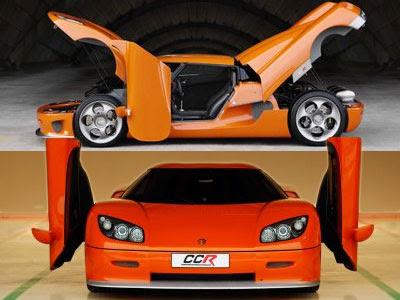
Koenigsegg CCR Design Sport Car Concept

Koenigsegg CCR Design Sport Car Concept

Koenigsegg design aims to give an interpretation of strength and flowing movement. The body of a Koenigsegg is formed for one ultimate aim, speed. Both the body and chassis of a Koenigsegg are made of lightweight composite carbon fiber, reinforced with Kevlar and aluminum honeycomb. Not surprisingly, the downside is very low downforce, just 50kg front and 70kg at the back. For comparison, an Enzo generates 775kg while Pagani produces 500kg. The entire body is carbon fiber.

Koenigsegg design aims to give an interpretation of strength and flowing movement. The body of a Koenigsegg is formed for one ultimate aim, speed. Its beauty is the beauty of speed itself. The surfaces are shaped to perfectly aerodynamic, something that does not deceive. All aspects of this machine serve its one fundamental objective with. Both the body and chassis of a Koenigsegg are made of lightweight composite carbon fiber, reinforced with Kevlar and aluminum honeycomb. Its race-bred suspension system brings the driver in control of every movement, even under the most difficult race.
The car was designed by Christian von Koenigsegg himself but its shape is largely dictated by aerodynamics. It is not so surprising as Enzo and Pagani. In some corners it seems too bulky, like a great whale. But the whale has a sense of power that can not be found in one of his rivals. Due to the targeted top speed, the body is designed to be so delicate that a very low drag coefficient of 0.30. This is much lower than Enzo (0.36), SLR (0.37) and the Carrera GT (0.39). Not surprisingly, the downside is very low downforce, just 50kg front and 70kg at the back.
For comparison, an Enzo generates 775kg while Pagani produces 500kg.
The frame is built like other supercar. Central to it is a carbon fiber tub (Koenigsegg called "semi-monocoque") attached with steel subframe at the front and the rear aluminum subframe to mount the engine, gearbox and suspension. Chassis rigidity is 28,100 Nm per degree, despite the roof plate. The entire body is carbon fiber. Koenigsegg says a dry weight of 1175 kg, which translates to 1275kg when fluid and fuel are loaded, ie, that which usually refer to "tare". In other words, is about CC8S light as Pagani and Saleen S7, whilst being around 100 kilograms lighter than Enzo and Carrera GT.

Thursday, January 13, 2011

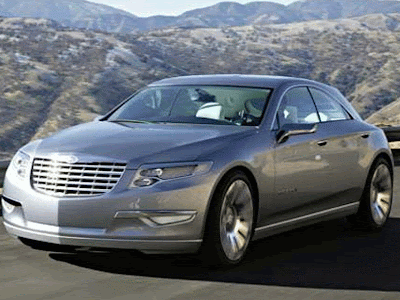
2011 New Chrysler Nassau Concept Cars will be launched later this year

According to U.S. sources the 2011 Chrysler Nassau will replace the Sebring as the next generation model (Chrysler Nassau concept cars pictured). The 2011 Chrysler Nassau will be the company's new mid-size sedan and will come on the market later this year. However, the 2011 Chrysler Nassau was not officially confirmed, nor denied for that matter. Although this name was used by the company for a 2007 concept cars , we should not expect the new 2011 Chrysler Nassau to look much like that concept.
2011 New Chrysler Nassau Concept Cars
The Chrysler designers have been working on completely new interior for the 2011 Chrysler Nassau and Dodge Avenger. The exterior will look substantially different. The 2011 Chrysler Nassau will offer the choice of two engines - 2.4-liter four-cylinder engine or a V6 Pentastar unit produced at Chrysler Trenton South engine plant.
Chrysler’s Sebring was never really anywhere near its competitors as far as its performance were concerned, which is why Chrysler has decided to make a fresh start with the car. And they have begun by giving the car a new name – Nassau – which is slated to hit the market in the last quarter of 2010 when it will replace the current Sebring.
The Nassau name plate was first seen on a concept car Chrysler had revealed in 2007. Chrysler also has a range of motorhomes available that are undergoing some modifications since earlier editions. Unlike the Sebring, motorhomes made by Chrysler are much larger and can accommodate more people in comfort. This type of vehicle is probably more suited to long distance travel and touring trips where motorhome hire is also an option for the vehicle.
The Chrysler’s Sebring is not being seen in good light of late, something that can be attributed to the sedan relying heavily on fleet and rental fleet sales with the majority of the grouse coming from the car’s interior quality which many claim is way behind what its competitors have on offer. Chrysler is of the opinion that the name ‘Sebring’ does not carry enough brand equity nor has any positive history associated with it that would make retaining the name for their all-new sedan really worthwhile.
“Chrysler bought the Nassau name when they came out with the concept, so it makes sense they would use it,” said Jim Hall, a consultant at a firm that is into advising automakers on future vehicles.
Another Chrysler Group model scheduled for replacement in the next 12 months is the Dodge Avenger. While little has been revealed on the new model (or whether it too will get a new name), previous reports suggested it would debut on a rear-wheel-drive platform as a sportier alternative to the Sebring.
That’s not all for there will also be an all-new Dodge Avenger to join the Nassau and is slated for a 2011 release with both the cars donning new interiors that Chrysler claims will match up to the best. The exteriors of the vehicles too will be a lot different so as to make them stand out as fresh new vehicles.
The 2011 Chrysler Nassau will be launched later this year. And The 2011 Chrysler Nassau price will be announced at a later date.

Wednesday, January 12, 2011

2010 Cadillac Sports Design Cars Concept SRV

This is the concept of next Cadillac. This concept is an idea from its Wayne Cherry who is responsible in making design concept. After a distinguished career at General Motors that culminated in his being appointed only the fifth vice president of design in the company’s history, he decided to build a concept car of his own.
2010 Cadillac Sports Cars SRV Concept
Wayne Cherry has always loved concept cars. Then you take a close look at Cherry’s VSR street rod, at the hardware, the workmanship, and, most of all, the design, and you realize it could easily take center stage as a concept car on the GM stand at the next international auto show.
"You just can't stop designing, you just can't stop being involved with cars," Cherry explains. "You start to do something like this, and it turns into a concept vehicle." He makes it sound like a winter garage project that got a little out of control, which at a basic level perhaps isn't a million miles from the truth.
Then you take a close look at Cherry's VSR street rod, at the hardware, the workmanship, and, most of all, the design, and you realize it could easily take center stage as a concept car on the GM stand at the next international auto show.
He joined GM in 1962, straight out of California’s Art Center design school, and was assigned to the advanced design studio at the Tech Center, where, among his first assignments, he assisted on a project that became the first Oldsmobile Toronado, one of the high watermarks of Bill Mitchell’s stint as GM design chief.
At Vauxhall, he worked on the gullwing XVR, the brand's first-ever concept car, which was unveiled at the 1966 Geneva show. His wild, mid-engine SRV, shown at the 1970 Earls Court Motor Show in London, was a four-door, four-seater that stood just 41 inches tall.
The Equus, one of the star concepts of 1978, was a crisp, state-of-the-moment roadster that rivaled the best from Bertone and Pininfarina. "That's the most uncompromised design I've ever worked on," Cherry said at the time.